#365songs (188 / 365)
Cerulean Salt was my first Waxahatchee album and I've been a fan ever since, all the way up to the quite different-sounding Tigers Blood. Back on her second album Katie Crutchfield was still very much in indie-rock mode, and following a trajectory I was familiar with from the Mountain Goats and Iron and Wine: a determinedly lo-fi acoustic-guitar first era (just one album in Waxahatchee and Iron and Wine's case) followed by very tentative exploration of other instrumentation in a studio, sooner or later going full-band and pretty much staying that way.
Cerulean Salt is from that tentative middle era of Waxahatchee and the clean-but-sparse sound leaves the emphasis on Crutchfield's lyrics, where it should be in a song like "Swan Dive," my favorite off Cerulean Salt. It's not a happy song but in some of its predictions of the future there's a bit of hopefulness to it that, insofar as it's autobiographical, was sort of borne out later ("I will grow out of all the empty bottles in my closet" prefiguring Crutchfield publicly getting sober in the Saint Cloud era). Mostly it's sad though, and simple as hell (four chords, three verses, wordless "oo-oo-oo" chorus) but extremely affecting. Live performances tend to slow it down and omit the constant tom roll but my favorite version is the studio one. Beautiful song, kind of a bummer. Kind of Phoebe Bridgers-esque, but 10 years before Phoebe Bridgers.
Crucial Connections
Others listening to this artist
Calamity Song
The Decemberists
#365songs (187 / 365)
Another song that's notable to me mainly for the music video, though the song is solid too. These absolute sickos (complimentary) actually recorded a music video that's just the Eschaton scene from David Foster Wallace's novel Infinite Jest (which novel blew me away when I read it as a 20-year-old). The song itself lightly references IJ in the lyric "In the year of the chewable Ambien tab" and otherwise doesn't lean into fan service, but the video is about as faithful a representation of the tennis-as-war-game set piece as you can get without embedding a child's head in a CRT monitor. Probably full of Easter eggs too, though the only one I noticed was Jenny Conlee wearing a classic DFW bandana. Directed by Michael Schur! One of like five directors whose names I recognize! What a miracle. I'm so glad this video exists.
Crucial Connections
Others listening to this artist
Now I Am an Arsonist
Jonathan Coulton
#365songs (186 / 365)
I like songwriters who surprise me, and Jonathan Coulton surprised me twice with Artificial Heart. I thought of him as a respectable songwriter but one who mostly did kinda gimmicky nerd-rock and/or joke songs: I mean, "Re: Your Brains?" "Skullcrusher Mountain?" "Code Monkey?" Come on. But Artificial Heart actually didn't entirely occupy the pigeonhole I'd put Coulton in. Sure, it had its share of mostly-goofy songs like "Nemeses" and "Je Suis Rick Springfield" and the songs from the end credits of the Portal games, but then it also had songs like "Now I Am an Arsonist," featuring, excuse me, Suzanne Vega??? That Suzanne Vega??
I actually think I may have purchased Artificial Heart unheard when I saw that particular feature, so unexpected and enticing was it. The song is a bit slight but it's one that I could learn and play myself without much difficulty, and it does have the lyrical ambiguity and emotional — I don't know if depth is the right word, but interest, at least — that surprised me about the album as a whole. And Suzanne Vega's voice sounds exactly the same as it did 25 years prior. It was very weird and cool to hear her harmonizing nicely alongside this guy I'd pegged as a trick pony. Not "one-trick," to be fair. "Re: Your Brains" and "Still Alive" are definitely two tricks. But a pony nonetheless. "Now I Am an Arsonist," however, is a full-grown-horse song.
Crucial Connections
Others listening to this artist
Commandante
The Mountain Goats
#365songs (185 / 365)
Many many years ago when I was maybe on the tail end of my "I Only Listen To The Mountain Goats" phase (I refer not to the podcast of that name but the actual time in my life when I listened almost exclusively to the Mountain Goats), I was looking at the music listening tracker last.fm and I noticed a fellow Mountain Goats fan whose most-listened song, by a wide margin, was "Commandante," which I had never heard. I messaged them to ask about it and they said, quote:
commandante is the best song in the history of the world. it's on devil in the shortwave, get into it.
So I got into it. Four days later, on July 4, I met a girl I'd been chatting with on OKCupid for a first date. Not too much later I gave her a Mountain Goats mix CD whose first song was "Commandante," which is the last track on the Devil in the Shortwave EP but makes a fantastic opening track due to its high energy and its multiple "I'm gonna" declarations of intent.
"Come summer, I am gonna treat you right," John Darnielle sings at the end of "Commandante"'s first verse. As in any relationship, I imagine, between two people with rather messed up families, I haven't always treated my partner right in our almost 20 years together, but I have done my best. We've seen the Mountain Goats together more than any other musical act, and it all started, in a way, with "Commandante," and it all started, in a way, on the 4th of July. A way better anniversary than the one most people think of.
Crucial Connections
Others listening to this artist
#365songs (184 / 365)
Solitude Standing is one of those albums from which I could probably pick seven or eight songs to write about. But everyone knows "Tom's Diner" and "Luka" so I'm picking a deep cut.
One of the strangest stories from my own personal mythology is that I taught myself to read at a young age, in part using liner notes. I don't remember doing this. But I do remember, when I was in middle or high school, cracking open the Solitude Standing jewel case and seeing horizontal indentations over every line in the lyric book where, years ago, I'd traced over them with something pointy while listening along. That one of the songs I apparently listened to was "In the Eye" kind of makes me wonder why I didn't grow up more disturbed than I did, but maybe instead it just seeded a lifelong preference for darker music.
Anyway, the things I remember about "Language" in particular are the time I was cuddling in silence with my junior-year high-school girlfriend outside after the after-prom party and sang a verse of this song to her, though I was then as now very self-conscious about my own singing. And then I remember, many years later, hearing it sampled in a Black Milk track and being absolutely dumbfounded by it. But here and now in 2026, with large language models smothering everything in a thick, oppressive layer of language-without-meaning, a 1987 song about the limits of language to capture and convey sounds pretty prescient.
Crucial Connections
Others listening to this artist
Winnie Hess (Learns to Party)
Walrus Promenade
#365songs (183 / 365)
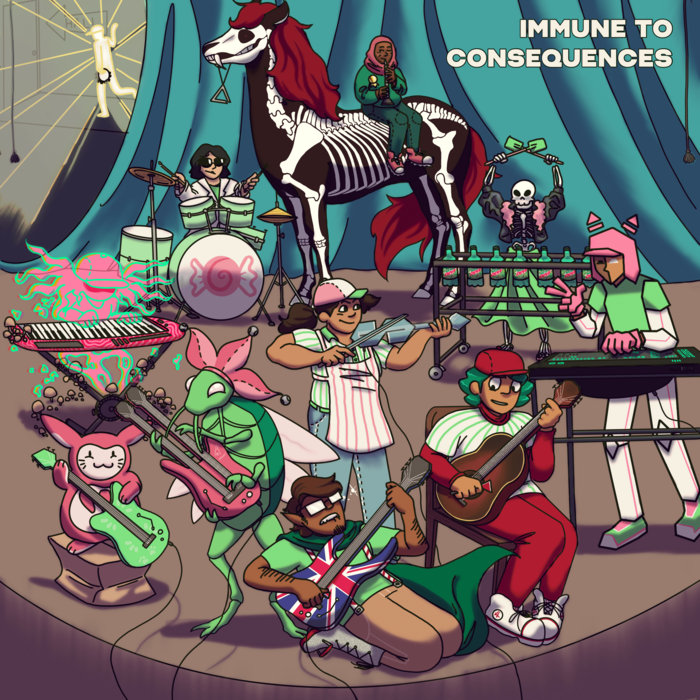
Hey did I mention about how I like midpoints? I put my most ambitious song yet in the middle of the album it's on, and yep, it's another Blaseball song. It's silly in retrospect (hell, it was silly at the time) but Blaseball did mean a lot to me when it was going on and for a little while thereafter, and I'm very happy that it sparked my interest so much that I wrung a whole album out of that inspiration.
Blaseball may have been a baseball simulator, but it was also a videogame, and players had star ratings indicating how good they were at various things, with a summary rating for their overall "level." Winnie Hess was a 9.4-star player at the end of her career — when many of Blaseball's best players were around 5 or 6 stars — and so I had the crazy idea to write a song that was 9.4 minutes long as a tribute to her. There's more information on the Bandcamp page for this song.
The song includes a special appearance from Boyfriend Monreal, one of the league's most beloved players and the cornerstone for the Kansas City Breath Mints' first serious playoff run until they were incinerated late in season 7. I got into Blaseball too late to follow their arc but they appear at the rough midpoint of Immune to Consequences in recognition of how formative they were for the team and its fanbase.
Because this is my own song, I can't listen back to it without Evaluating it, and as a song, I think "Winnie Hess" is pretty good. My songwriting and performance style owes a lot to the Mountain Goats, who showed me that you can make incredibly compelling music with minimal technical skill as long as your songwriting is on point, and though I thought "Winnie Hess" was not much like a Mountain Goats song, when I first posted it publicly one of the comments it got was "Sounds like the Mountain Goats!" I'm fine with this. The song's main shortcoming, to me, is my singing, which is okay but needs a little more variety and character and just oomph for such a big, ambitious song. It's too timid. And I guess it's really wordy in places, which is understandable for a story song but maybe makes it drag a bit in the middle. But I do think mixing up the instrumentation (which practice I cribbed from the Fiery Furnaces) over the course of the 9 minutes keeps it relatively engaging. All in all, an imperfect song, but I'm happy I swung for the fences with it.

The Past is a Grotesque Animal
of Montreal
#365songs (182 / 365)
I like midpoints. Especially in books, I love to reach some plot cataclysm that fundamentally changes the story, or upends what the characters (and/or the reader) thought they knew, and realize that I'm on page 235 of a 570-page book. (Paradoxically, I also think the one undeniable benefit of e-readers over physical books is that you can turn off page numbers altogether, so that you don't know how much is left in a book and thus how much time it has to wrap everything up — or not — but I digress.)
Anyway, I love when musicians do something with album midpoints too, and "The Past is a Grotesque Animal" is one of the biggest album-midpoint curveballs I know. Approximately smack in the middle of the otherwise peppy, catchy electro-pop-inflected Hissing Fauna, Are You The Destroyer?, it's a structureless, oppressive, ominous cri de coeur that only flirts with melody for its 12-minute runtime but is still kind of catchy somehow. Kevin Barnes sings a series of seeming non-sequiturs, occasionally repeating a line either because it feels especially true or just because it's a great phrase or maybe just to fill time. It all feels very improvised, but who knows if it is. It's almost totally different from the rest of Hissing Fauna — except that it's still a Kevin Barnes song and Kevin Barnes can only ever sound like himself no matter what kind of crazy stylistic experiment he happens to be indulging in — and the album would be a very different (and, I would argue, lesser) thing without it.
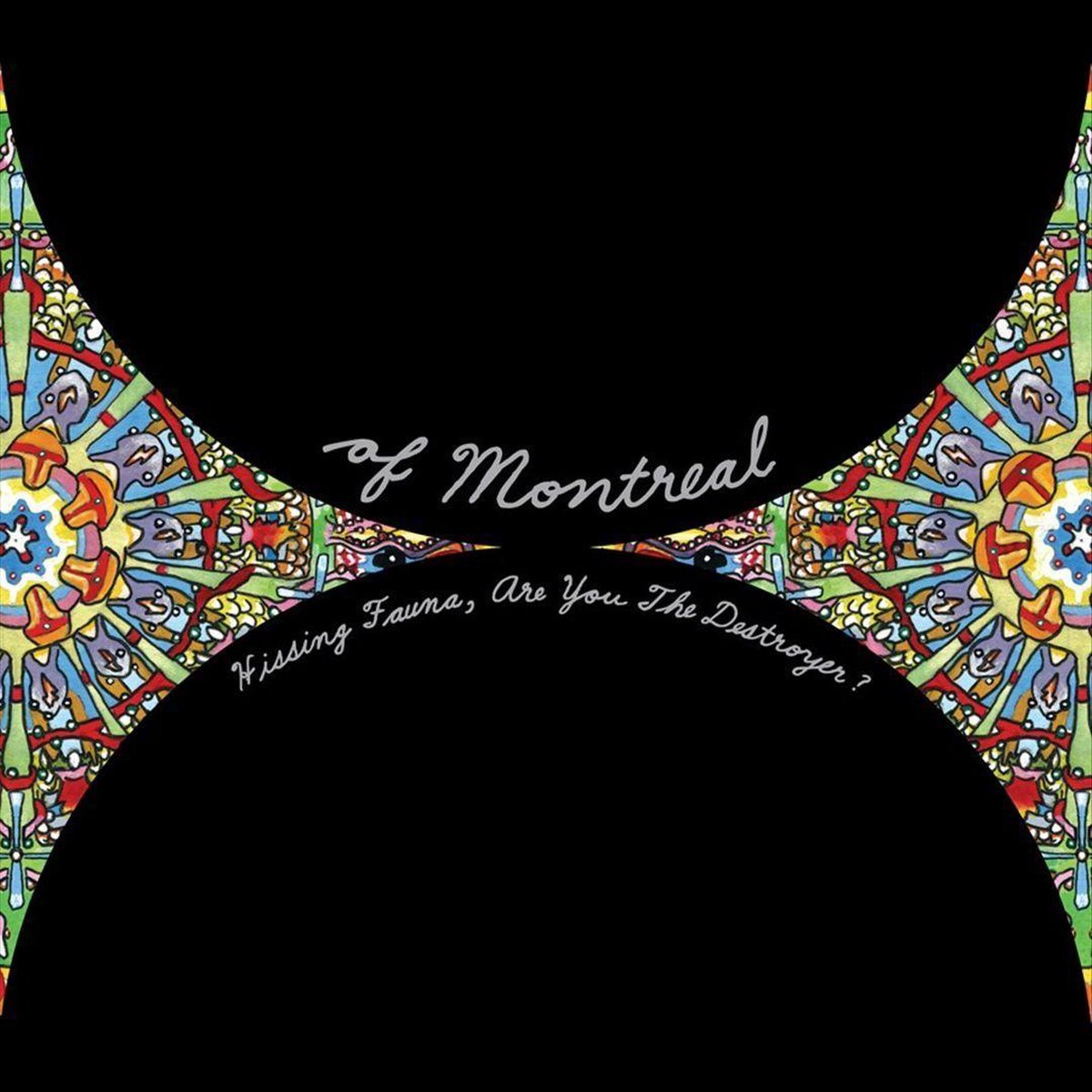
I have to mention that another part of what makes "The Past is a Grotesque Animal" so structurally appealing to me is the (original? physical?) album art, which I've attached because it's different on Bandcamp. of Montreal albums of this era tended to be absolutely overwhelmingly riotously busy with color and intricate detail, and Hissing Fauna is no exception... but for the two black semicircles (cardboard flaps on the physical art, I think?) that encroach from top and bottom. "Reading" the album art left to right, they meet right at the middle. There's a darkness to all of Hissing Fauna, which is largely about the dissolution of Kevin Barnes's marriage, but "The Past is a Grotesque Animal" is where those black semicircles meet: it's where he manically gives himself over to his rage and self-loathing and despair entirely. But it is, somehow, I repeat, still kind of catchy.
Crucial Connections
Others listening to this artist

wtf is self care
Open Mike Eagle
#365songs (181 / 365)
The equally short but inverse counterpart to yesterday's entry. It is, admittedly, still beaten-down. But it's fucking hilarious, basically a series of one-liners with the delivery of a stand-up comic but the cadence and rhymes of a rap song. I love that this track and "everything ends last year" are so concise and so different tonally but both make perfect sense in the context of Anime, Trauma and Divorce.
Crucial Connections
Others listening to this artist
everything ends last year
Open Mike Eagle
#365songs (180 / 365)
One of two short, powerful tracks on Open Mike Eagle's Anime, Trauma and Divorce that bracket the considerable emotional spectrum spanned by this great album. This one is the bummer, a beaten-down lament of a series of losses Mike suffered in 2019. The near-beatless instrumentals build over each of four verses and then the bottom drops out abruptly on the word "ended." Oof. Just that much would be a brutally effective synthesis of form and content, but where the first three verses each give way to a dispirited, muttered aside, the fourth breaks the pattern, like that one still hurts too much to say any more about. Rough stuff, but a magnificent 140 seconds of music.
Crucial Connections
Others listening to this artist
#365songs (179 / 365)
OK, I've done a lot of very responsible and serious or at least earnest posts about songs that I love. "Fly Away" is the first song that comes to my mind when I ask myself about songs I hate. It's that opening stanza. It's "Baby's First Rhyme" and there's no recovering from it. I can't say anything about this song that Pat Finnerty doesn't say better in his "What Makes This Song Stink" video on this and "American Woman," another fairly awful song that is not as bad as "Fly Away."
I know in my last post I wrote approvingly about the concept of rock 'n' roll that embraces human idiocy and does things you can't get away with in other contexts. I stand by all that. But "Fly Away" is too idiotic, and it doesn't get away with it. Bad song.